
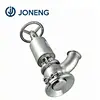
Tank Bottom Valve
Tank bottom valve is a specialized valve installed at the bottom of various types of storage tanks, used to control the discharge, discharge or cut-off of the medium inside the tank. It has the characteristics of good sealing performance and convenient opening and closing, and is the core control component of the tank discharge system.Widely used in industries such as petrochemicals, food and pharmaceuticals, grain and oil processing, and daily chemical products, it is suitable for various storage tanks such as raw material tanks, finished product tanks, and ingredient tanks. It is responsible for precise unloading of liquid and slurry media in the tanks, preventing medium leakage, and ensuring the safety and efficiency of the tank discharge process.
Common Types
- Manual tank bottom valve: Handwheel driven, easy to operate, suitable for small and medium-sized tanks, low-frequency unloading scenarios
- Pneumatic storage tank bottom valve: driven by compressed air, with fast opening and closing speed, suitable for remote control of automated production lines
- Sanitary grade tank bottom valve: mirror polished valve body+food grade seal, meeting the sterile unloading needs of the food and pharmaceutical industries
- Discharge ball valve type bottom valve: ball valve core design, smooth flow channel, suitable for unloading storage tanks containing granular media
Structural Advantages & Corresponding Benefits
-
Mirror polished valve core structure without blind spots
- Special point: The valve core is made of 304/316L stainless steel forged as a whole, and the flow channel is mirror polished to Ra ≤ 0.8 μ m, with no residual dead corners.
- Result:Eliminate residual media and bacterial growth, adapt to CIP online cleaning, and meet the hygiene standards of the food and pharmaceutical industry.
-
Double sealed leak proof structure
- Special point: Adopting food grade PTFE+rubber composite seal, and adding packing seal at the valve stem.
- Result:Achieving zero leakage sealing effect, preventing the evaporation or contamination of the medium inside the tank, and ensuring the safety of unloading operations.
All Products(151)



- 1
- 2
- 3
- 4
- 19