
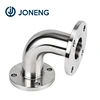
Stainless steel steel bend
Stainless steel bends are sanitary pipeline components primarily made from 304 or 316L stainless steel, designed to smoothly change the direction of fluid flow while maintaining high hygiene and structural reliability. With characteristics such as high corrosion resistance, smooth inner surface, easy cleaning, and excellent mechanical strength, stainless steel bends are manufactured according to strict sanitary standards including 3A, FDA, DIN, ISO, and SMS. They are widely used in industries with high cleanliness requirements, including food, beverage, pharmaceutical, dairy, bioengineering, and daily chemical industries, providing safe and efficient fluid transportation solutions for sanitary pipeline systems.
Common Types
- 90° Stainless Steel Bend: Changes the pipeline direction by 90 degrees,commonly used in sanitary processing lines and equipment connections.
- 45° Stainless Steel Bend: Provides a gradual direction change, reducing turbulence and pressure loss, suitable for pipelines requiring smoother fluid flow.
- 180° Stainless Steel Bend: Enables complete flow reversal and is often used in circulation loops and return pipelines.
- Long Radius Bend: Features a larger bending radius, reducing flow resistance and minimizing fluid retention, suitable for high-flow sanitary systems.
Structural Advantages & Corresponding Benefits
-
Integrated Forming & Smooth Inner Wall Structure
- Special point: Manufactured through precision bending or formingprocesses, with CNC polishing of the inner flow channel, achieving surfaceroughness of Ra ≤ 0.8μm, with no sharp corners or internal grooves
- Result:Minimizes fluid residue and bacterial growth, supports CIP/SIPcleaning and sterilization processes, and meets the aseptic requirementsof pharmaceutical, dairy, and food production systems.
-
One-piece Stainless Steel Construction & Corrosion-resistant Design
- Special point: Made from high-quality 304 or 316L stainless steelfeaturing excellent resistance to corrosion, oxidation, and chemicalcleaning agents
- Result: Ensures long-term stable operation in humid, acidic, alkaline, andfrequently cleaned environments, extending service life while maintaininghygienic performance.
All Products(12)


- 1
- 2