
Manifold
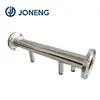
A manifold is a pipeline distribution component that integrates multiple sets of inlet and outlet pipes. Through the integrated design of the main pipeline and several branch pipelines, it realizes the multi-channel distribution of a single fluid or the convergence and integration of multiple fluids. It is the core device for centralized control of medium transportation in industrial fluid systems.Widely used in industries such as petrochemicals, hydraulic systems, water treatment, food and pharmaceuticals, and new energy, it is installed at fluid distribution hub nodes and used for hydraulic station oil circuit distribution, cooling water system diversion, chemical raw material proportioning and transportation, pharmaceutical sterile fluid diversion and filling, etc. It achieves precise diversion, convergence, and centralized control of media.
Common Types
- Divided by purpose: hydraulic manifold (suitable for high-pressure hydraulic systems), fluid distribution manifold (general industrial diversion), sanitary grade manifold (for food and pharmaceutical clean working conditions), gas manifold (for gas delivery distribution)
- Divided by material: carbon steel manifold, stainless steel (304/316L) manifold, aluminum alloy manifold, plastic manifold
- Divided by connection method: flange connection manifold, threaded connection manifold, quick fit clamp manifold (sanitary grade)
Structural Advantages & Corresponding Benefits
-
Integrated structure forged as a whol
- Special point:Adopting integral forging forming process, without splicing welds, the branch pipe mouth and main pipe are integrally formed, and the aperture and flow rate are precisely matched in the design.
- Result:Excellent pressure resistance, eliminating the risk of leakage, no flow deviation in fluid distribution, and suitable for stable operation under high pressure conditions.
-
Modular Port Standardization Structur
- Special point: The branch port adopts a standardized interface design, with reserved installation positions for instruments/valves, and the inner wall is polished (Ra ≤ 0.8 μ m) without dead corners.
- Result: Compatible with different specifications of pipeline accessories, easy installation and maintenance, reduced medium residue, and adaptable to fluid distribution needs in multiple scenarios.
All Products(18)


- 1
- 2
- 3