


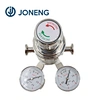


Stainless Steel water pilot operated hydraulic brass fanged ul pressure reducing valve
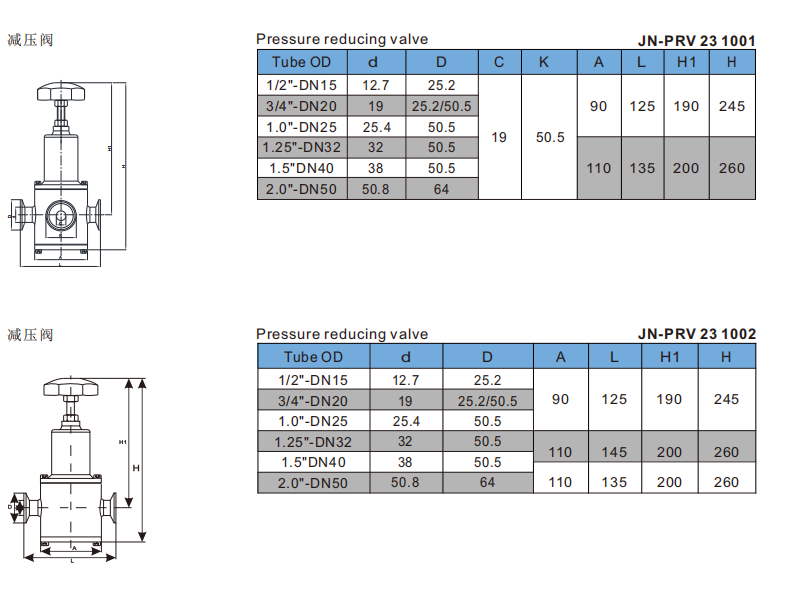
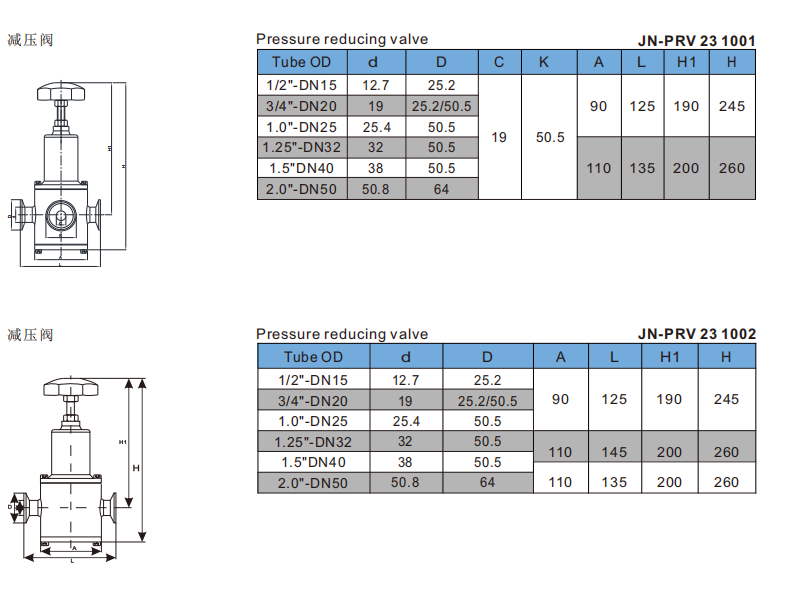
JN-PRV 23 1002-4
Size Range: 1/2″–2″, DN15–DN50
Material Grade: AISI304, AISI316L (corrosion-resistant, suitable for sanitary and aggressive media)
Standard: DIN (German Industrial Standard), 3A (American Sanitary Standard)
Maximum Pressure: 0 to 10Bar
Maximum Temperature: –15℃ to 148℃
Seal Options: PTFE seals (for broad chemical compatibility) or Viton seals (for higher temperature and oil/gas resistance)
Material Grade: AISI304, AISI316L (corrosion-resistant, suitable for sanitary and aggressive media)
Standard: DIN (German Industrial Standard), 3A (American Sanitary Standard)
Maximum Pressure: 0 to 10Bar
Maximum Temperature: –15℃ to 148℃
Seal Options: PTFE seals (for broad chemical compatibility) or Viton seals (for higher temperature and oil/gas resistance)
Quantity:
Recommend Products
 Sanitary Stainless Steel Three Way Clamped Pressure Reducing ValveSize Range: 1/2″–2″, DN15–DN50 Material Grade: AISI304, AISI316L (corrosion-resistant, suitable for sanitary and aggressive media) Standard: DIN (German Industrial Standard), 3A/SMS (American Sanitary Standard),ISO (International Standard) Maximum Pressure: 0 to 10Bar Maximum Temperature: –15℃ to 148℃ Seal Options: PTFE seals (for broad chemical compatibility) or Viton seals (for higher temperature and oil/gas resistance)JN-PRV 23 1001
 Stainless Steel Sanitary Mini Water Pressure Reducing ValveSize Range: 1/2″–2″, DN15–DN50 Material Grade: AISI304, AISI316L (corrosion-resistant, suitable for sanitary and aggressive media) Standard: DIN (German Industrial Standard), 3A/SMS (American Sanitary Standard),ISO (International Standard) Maximum Pressure: 0 to 10Bar Maximum Temperature: –15℃ to 148℃ Seal Options: PTFE seals (for broad chemical compatibility) or Viton seals (for higher temperature and oil/gas resistance)JN-PRV 23 1001-2
 Stainless Steel Spring Piston Water Pressure Reducing ValveSize Range: 1/2″–2″, DN15–DN50 Material Grade: AISI304, AISI316L (corrosion-resistant, suitable for sanitary and aggressive media) Standard: DIN (German Industrial Standard), 3A/SMS (American Sanitary Standard),ISO (International Standard) Maximum Pressure: 0 to 10Bar Maximum Temperature: –15℃ to 148℃ Seal Options: PTFE seals (for broad chemical compatibility) or Viton seals (for higher temperature and oil/gas resistance)JN-PRV 23 1001-3
 Stainless Steel Boiler Steam Pressure Reducing ValveSize Range: 1/2″–2″, DN15–DN50 Material Grade: AISI304, AISI316L (corrosion-resistant, suitable for sanitary and aggressive media) Standard: DIN (German Industrial Standard), 3A/SMS (American Sanitary Standard),ISO (International Standard) Maximum Pressure: 0 to 10Bar Maximum Temperature: –15℃ to 148℃ Seal Options: PTFE seals (for broad chemical compatibility) or Viton seals (for higher temperature and oil/gas resistance)JN-PRV 23 1001-4

Stainless Steel water pilot operated hydraulic brass fanged ul pressure reducing valve
The Stainless Steel Sanitary Mini Steam Pressure Reducing Valve is a precision valve designed for hygienic process lines. Its fanged pressure reducing valve primary function is to manually lower and maintain a consistent, pre-set outlet pressure regardless of higher, fluctuating inlet pressures. It is typically installed in sanitary stainless steel pipelines within the food, beverage, and pharmaceutical industries, often downstream from pumps or before sensitive equipment. This placement protects downstream apparatus, ensures process stability, and brass pressure reducing valve guarantees product quality. Key variants include direct-acting and pilot-operated designs, available with clamp, flange, or threaded connections to meet specific system and cleaning requirements.
Stainless Steel Sanitary Mini Steam Pressure Reducing Valve is engineered specifically for hygienic applications, which fundamentally distinguishes it from ordinary industrial pressure reducing valves. While standard valves focus on basic pressure control in utility systems, our product features a sanitary-grade design with polished surfaces and crevice-free construction to meet strict cleanliness standards, preventing contamination and allowing thorough sterilization. Key advantages over competitors include broader material compatibility through selectable PTFE or Viton seals, a more extensive operational temperature range, and consistent performance across the entire 0 to 10 bar pressure spectrum. These features make it the preferred choice for precision pressure regulation in critical industries like pharmaceuticals and food processing.
Accessories
Component & Material Table
- Valve body: 304, 316L. 316L is suitable for more corrosive media.
- Valve cover: 304, 316L. Made of the same material as the valve body to ensure structural integrity.
- Valve core/disc: 304, 316L. Often hard-polished or plated to improve wear resistance and sealing performance.
- Spring: 304, 316L stainless steel spring, corrosion resistant and maintains pressure regulation stability.
- Seals: PTFE, Viton (FKM). PTFE is suitable for a wide range of chemical media; Viton is resistant to high temperatures and oil media.
- Handwheel/adjusting knob: 304 stainless steel. Surface can be polished or sandblasted.
- Connectors: 304, 316L. Includes clamps, threads, flanges, and other interface components.
Product Parameter Details
- Material: AISI 304 (General Purpose), AISI 316L (High Corrosion Resistance)
- Structure: Standard, Jacketed (for insulation or cooling), Diaphragm (High Sensitivity), Piston (High Pressure)
- Pressure Range: Working pressure: 0–10 bar; Test pressure: ≥1.5 times working pressure; High-pressure models can be designed according to requirements.
- Classification: Sanitary (3A, FDA standard), Chemical (ISO standard), Aseptic (ASME BPE)
- Certifications: Sanitary: 3A, EHEDG, FDA; Safety: PED (2014/68/EU), CE; Industry Certifications: GMP, ISO 9001
- Installation: Generally supports horizontal installation; some models can be installed vertically (spring load design needs confirmation)
- Customization Options: Special sizes (non-standard diameters), special functions (remote control interface, pressure feedback signal), material certificate (EN 10204 3.1), samples available.

Stainless Steel water pilot operated hydraulic brass fanged ul pressure reducing valve
Feature (F)、Advantage (A)、Benefit (B)
- Aseptic structure:
- F: Constructed from 304/316L stainless steel using fully automated mirror polishing and sanitary-grade welding processes.
- A:Achieves zero dead corners and no residue internally, ensuring the highest level of cleanliness.
- B: Guarantees absolute product safety and easily passes stringent hygiene audits.
- Pressure Stabilizing Design:
- F: The core utilizes a precision handwheel with a dial and a piston-type balanced valve core structure.
- A: Provides linear and precise pressure fine-tuning and automatically compensates for upstream pressure fluctuations.
- B: Ensures your critical production process parameters remain at their most stable state.
- Long-Lasting Sealing:
- F: All internal key seals use certified composite diaphragms and specially designed sealing rings.
- A:Guarantees long service life and zero-leakage sealing even under high temperatures, corrosion, and frequent operation.
- B: Significantly reduces downtime, maintenance, and replacement costs due to valve leakage or damage.
- Online Monitoring:
- F: Standard design includes dual pressure gauge interfaces and supports online cleaning and sterilization.
- A: Facilitates real-time monitoring and efficient cleaning and sterilization without disassembly.
- B:Saves you significant manual cleaning time and significantly improves equipment utilization.
- Rapid Maintenance:
- F: The overall modular design allows for quick replacement of vulnerable parts.
- A: Makes maintenance extremely simple, requiring no special tools or professional skills.
- B: When maintenance is needed, your production line can be restored to operation in the shortest possible time.

Stainless Steel water pilot operated hydraulic brass fanged ul pressure reducing valve
Interface Mode:Offers various sanitary connection options including Tri-Clamp clamps, sanitary threads, and butt welding.
Production & Processing Method:The valve body is precision CNC machined and forged to ensure dimensional accuracy and structural strength.
Surface Treatment:The flow channels are mechanically or electrolytically polished to a mirror finish, achieving a sterile surface.
Raw Material Processing Method:The main body is made of 304/316L stainless steel forgings, while internal components are precision machined from bars and plates.
Operation Mode:Manually adjustable with a precision-scaled handwheel, offering intuitive operation and linear adjustment.
Seal Ring Material Options:Standard option includes FDA-certified sanitary seals such as EPDM, silicone, or PTFE.
Sealing Method:Employs a balanced piston and composite diaphragm dynamic seal combined with an O-ring static seal.




Send Message