
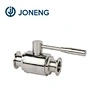



Stainless Steel pneumatic actuated sanitary flange end floating ball valve
JN-ZWBLV 1001-1
Size: DN15 – DN150 (1″– 6″, O.D. Ф12.7 – Ф152.4)
Grade: Valve body manufactured from high-quality stainless steel SUS304 or SUS316L, selected to suit various corrosion resistance needs
Standard: Conforms to ISO, DIN, IDF, SMS, 3A, and other internationally recognized sanitary standards
Working Pressure: 1.0 MPa (PN10 bar)
Test Pressure:
Shell hydrostatic test: 2.4 MPa
Hydrostatic seat seal test: 1.8 MPa
Temperature Range: -10℃ to +150℃ (steam sterilization up to 150℃ for max 20 min)
PTFE Seals: Standard PTFE seats offer excellent sealing performance, corrosion resistance, and self-lubricating properties, suitable for a wide temperature range
Viton Seals: Optional Viton (FPM) O-rings are available for applications requiring enhanced resistance to high temperatures and aggressive chemicals
Grade: Valve body manufactured from high-quality stainless steel SUS304 or SUS316L, selected to suit various corrosion resistance needs
Standard: Conforms to ISO, DIN, IDF, SMS, 3A, and other internationally recognized sanitary standards
Working Pressure: 1.0 MPa (PN10 bar)
Test Pressure:
Shell hydrostatic test: 2.4 MPa
Hydrostatic seat seal test: 1.8 MPa
Temperature Range: -10℃ to +150℃ (steam sterilization up to 150℃ for max 20 min)
PTFE Seals: Standard PTFE seats offer excellent sealing performance, corrosion resistance, and self-lubricating properties, suitable for a wide temperature range
Viton Seals: Optional Viton (FPM) O-rings are available for applications requiring enhanced resistance to high temperatures and aggressive chemicals
Quantity:
Download directory
Recommend Products
 Stainless Steel flange high pressure gas ball valveSize: DN15 – DN150 (1″– 6″, O.D. Ф12.7 – Ф152.4) Grade: High-quality stainless steel SUS304 or SUS316L, selected to suit various corrosion resistance needs Standard: Conforms to ISO, DIN, IDF, SMS, 3A, and other internationally recognized standards Working Pressure: 1.0 MPa (PN10 bar) Test Pressure: Shell hydrostatic test: 2.4 MPa Hydrostatic seat seal test: 1.8 MPa Temperature Range: -10℃ to +150℃ (steam sterilization up to 150℃ for max 20 min) PTFE Seals: Standard PTFE seats offer excellent sealing performance, corrosion resistance, and self-lubricating properties, suitable for a wide temperature range Viton Seals: Optional Viton (FPM) O-rings are available for applications requiring enhanced resistance to high temperatures and aggressive chemicalsJN-3WBLV 1005-1
 Stainless Steel floating flange end electric actuated ball valveSize: DN15 – DN150 (1″– 6″, O.D. Ф12.7 – Ф152.4) Grade: High-quality stainless steel SUS304 or SUS316L, selected to suit various corrosion resistance needs Standard: Conforms to ISO, DIN, IDF, SMS, 3A, and other internationally recognized standards Working Pressure: 1.0 MPa (PN10 bar) Test Pressure: Shell hydrostatic test: 2.4 MPa Hydrostatic seat seal test: 1.8 MPa Temperature Range: -10℃ to +150℃ (steam sterilization up to 150℃ for max 20 min) PTFE Seals: Standard PTFE seats offer excellent sealing performance, corrosion resistance, and self-lubricating properties, suitable for a wide temperature range Viton Seals: Optional Viton (FPM) O-rings are available for applications requiring enhanced resistance to high temperatures and aggressive chemicalsJN-3WBLV 1005-2
 Stainless Steel mini gas 3-piece actuated ball valveSize: DN15 – DN150 (1″– 6″, O.D. Ф12.7 – Ф152.4) Grade: High-quality stainless steel SUS304 or SUS316L, selected to suit various corrosion resistance needs Standard: Conforms to ISO, DIN, IDF, SMS, 3A, and other internationally recognized standards Working Pressure: 1.0 MPa (PN10 bar) Test Pressure: Shell hydrostatic test: 2.4 MPa Hydrostatic seat seal test: 1.8 MPa Temperature Range: -10℃ to +150℃ (steam sterilization up to 150℃ for max 20 min) PTFE Seals: Standard PTFE seats offer excellent sealing performance, corrosion resistance, and self-lubricating properties, suitable for a wide temperature range Viton Seals: Optional Viton (FPM) O-rings are available for applications requiring enhanced resistance to high temperatures and aggressive chemicalsJN-3WBLV 1005-3
 Stainless Steel industry one piece fire safe pneumatic ball valveSize: DN15 – DN150 (1″– 6″, O.D. Ф12.7 – Ф152.4) Grade: High-quality stainless steel SUS304 or SUS316L, selected to suit various corrosion resistance needs Standard: Conforms to ISO, DIN, IDF, SMS, 3A, and other internationally recognized standards Working Pressure: 1.0 MPa (PN10 bar) Test Pressure: Shell hydrostatic test: 2.4 MPa Hydrostatic seat seal test: 1.8 MPa Temperature Range: -10℃ to +150℃ (steam sterilization up to 150℃ for max 20 min) PTFE Seals: Standard PTFE seats offer excellent sealing performance, corrosion resistance, and self-lubricating properties, suitable for a wide temperature range Viton Seals: Optional Viton (FPM) O-rings are available for applications requiring enhanced resistance to high temperatures and aggressive chemicalsJN-3WBLV 1005-4

Stainless Steel pneumatic actuated sanitary flange end floating ball valve
The Stainless Steel pneumatic actuated sanitary flange end floating ball valve is a sanitary fluid control valve designed for clean process pipelines in industries such as food, pharmaceuticals, and personal care. Installed at pipeline shut-off or switching points, it utilizes a pneumatic actuator to rotate the ball 90 degrees, enabling rapid opening/closing and Flange End Ball Valve precise control of the medium. Available with various connection types (quick-connect, welded, or threaded) and pneumatic actuated ball valve seal materials (EPDM, PTFE, or silicone), it replaces manual operation with pneumatic actuation. This sanitary ball valve meets the sterility standards of clean environments and the demands of automated production, ensuring both hygienic safety and efficient operation of the piping system.
ThisStainless Steel pneumatic actuated sanitary flange end floating ball valve is primarily composed of core components such as a stainless steel valve body, ball, stem, seals (sealing rings and gaskets), pneumatic actuator, and quick-connect clamp fittings. Accessories include clamps, gaskets, limit switches, and solenoid valves. Designed for clean process pipelines in industries like food and pharmaceuticals, it utilizes a quick-connect clamp structure to ensure a hygienic, crevice-free, and easily demountable sealed connection without the need for welding, thereby meeting aseptic standards and facilitating convenient maintenance. Once installed, the valve enables rapid flow control (on/off), zero-leakage sealing, and automated remote operation, ensuring the hygiene, safety, and efficient performance of the piping system. Its operating principle involves the pneumatic actuator receiving compressed air through ports A and B to drive an internal piston, which rotates the stem by 90 degrees; the stem simultaneously turns the ball within the valve body. When the ball's bore aligns with the pipeline axis, the valve is fully open, allowing smooth media flow; when the ball rotates 90 degrees so that the bore is perpendicular to the pipeline, the valve is fully closed, completely shutting off the flow. The product offers various actuation options: in addition to the standard pneumatic actuator, it can be configured with a manual handle (for small-bore, on-site operation) or an electric actuator (for remote automation and precise regulation) based on specific operational needs. Furthermore, customizable options—such as various sealing materials and connection types—are available to suit diverse media and process requirements.
Accessories
Component & Material Table
- Valve Body & Ball:304/316L Stainless Steel (sanitary-grade forging)
- Valve Seat & Seal Ring:PTFE/EPDM (food-grade, corrosion-resistant)
- Manual Handle:304 Stainless Steel/Aluminum Alloy (anti-slip)
- Quick-clamp Fitting:304/316L Stainless Steel (polished finish)
- Valve Stem:304/316L Stainless Steel (wear-resistant)
Product Parameter Details
- Material:Main body: 304/316L stainless steel; Seals: food-grade PTFE/EPDM; Handle: 304 SS/aluminum alloy
- Structure Form:Standard: three-way L/T port, clamp-type quick-install; Optional: jacketed structure for temperature control
- Pressure Rating:PN10/PN16; 150PSI (working pressure); Test pressure: 1.5× working pressure
- Function:Flow direction switching, media merging, fluid diversion; on-off control for hygienic pipelines
- Grade Classification:Hygiene grade: 3A/DIN 11851; Industry grade: sanitary-grade (for food/pharma), no industrial-grade option
- Specification Match:Standards: DIN (German), SMS (Swedish), 3A (American), ISO (international); Size range: 1/2"–4"
- Certification Grade:Hygiene certification: 3A, FDA; Safety certification: CE, ISO 9001
- Installation Direction:Horizontal/vertical installation (no flow direction restriction; handle upward for easy operation)
- Customization Service:Custom size (5"+), special seal material (Viton), jacketed structure; sample support for testin
Digital advantages
- 1. Material and Corrosion Resistance Advantages:Our stainless steel industrial-grade one-piece, threadless ball valve features a 100% forged virgin 304/316L stainless steel body, conforming to ASTM A351 material standards. It uses industrial-grade PTFE/EPDM seals (Viton optional), achieving 1000 hours of salt spray resistance without rust. Suitable for highly corrosive environments such as petroleum, chemical, and water treatment, it eliminates the risk of media contamination and meets global export environmental and hygiene requirements.
- 2. Structural and Sealing Advantages:The product adopts a one-piece forged valve body structure with no splicing leakage points. The ball is precision-machined using CNC machining, with roundness tolerance controlled within ±0.01mm. Combined with a double sealing ring design, it achieves zero leakage across a full pressure range of 1.6-6.4MPa. It passes GB/T 13927 sealing performance testing, features a 90° quick-opening and closing structure, and has a switching life exceeding 100,000 cycles. It operates without leakage for extended periods, making it suitable for harsh industrial pipeline conditions.
- 3. Installation and Adaptation Advantages: Standard NPT/BSPT standard threaded interface, nominal diameter covering DN6-DN100 (1/4"-4"), conforming to ASME B16.34 international standard, with no installation direction restrictions, allowing for quick pipeline connection without special tools, improving installation efficiency by 60% compared to welded valves. Adaptable to various media such as water, gas, and oil, compatible with manual/pneumatic/electric drive methods, meeting customized needs in different industrial scenarios.
- 4. Process and Quality Control Advantages: The entire process is CNC machined, achieving IT7 level dimensional accuracy for the valve body, with an inner wall roughness Ra≤0.8μm, effectively reducing media pressure loss. 100% of valves undergo water pressure strength testing (1.5 times nominal pressure) and air pressure sealing testing (1.1 times nominal pressure) before leaving the factory, with a 100% pass rate. Certified for export, including CE and FDA, the quality control system complies with ISO 9001 standards, ensuring consistent delivery to global customers.
- 5. Delivery and Service Advantages: Direct supply from our own factory, with over 5,000 units in stock of standard specifications, ensuring delivery within 72 hours. We also support non-standard customization (special materials, pressure ratings, interface types), with a delivery cycle of ≤15 days. We provide all-English technical documentation and export customs clearance documents, along with a 12-month warranty and lifetime maintenance service. Third-party testing reports can be provided upon request, helping overseas clients quickly complete project implementation and compliance acceptance.

Stainless Steel pneumatic actuated sanitary flange end floating ball valve
Feature (F)、Advantage (A)、Benefit (B)
1. Raw Materials
F: The valve body, ball, and stem are forged as a single unit from AISI 304/316L low-carbon, sanitary-grade stainless steel—eliminating seams and excess material. Material traceability is ensured via heat number certification, with options for customized thicker bodies and special alloys.
A: The integral forged structure eliminates the risk of intergranular corrosion. It offers resistance to weak acids, alkalis, and chloride ion corrosion, withstands repeated high-temperature CIP/SIP sterilization cycles without deformation, maintains stable mechanical properties, and prevents the leaching of harmful substances.
B: Addresses common industry issues—such as weld cracking and material inconsistency—at the source. Complies with FDA/GMP standards, significantly extends service life under high-pressure conditions, and reduces customer O&M costs.
2. Manufacturing Process
F: The valve body and ball are forged as one piece without welded seams. The flow path features an ultra-smooth mirror finish (Ra ≤ 0.4μm), sealing surfaces are precision-lapped, and coaxiality tolerance is controlled within ±0.05mm.
A: High-precision fit between the ball and seat ensures seals remain stable and wear-free during long-term operation. The ultra-smooth flow path prevents media adhesion and eliminates cleaning dead zones, thereby preventing microbial growth and media entrapment.
B: Resolves issues associated with rough flow paths and cleaning dead zones found in conventional ball valves. Greatly simplifies cleaning validation, cuts cleaning time by over 50%, and ensures aseptic compliance for large-scale production in highly corrosive environments.
3. Structural Design
F: Features a two-way full-bore flow path, a center-rotating ball mechanism, and a smooth, arc-transition design with no dead zones. Equipped with quick-clamp connections at both ends, the compact forged structure incorporates a flow path optimized via fluid dynamics.
A: Free from crevices that trap dirt or dead zones where media might stagnate. Designed for smooth, high-flow operation—eliminating turbulence, foaming, and media stratification. The full-bore structure minimizes flow resistance, allows for flexible installation, and is suitable for continuous high-pressure transfer applications. B: Overcomes industry pain points associated with conventional ball valves—such as flow path dead zones, cleaning difficulties, and high flow resistance—ensuring batch consistency during high-flow transfer, suitability for large-scale continuous production in clean zones, and reduced costs associated with unplanned downtime.
4. Features and Advantages
F: Standard sanitary quick-clamp connections; direct-drive pneumatic actuator; tool-free assembly/disassembly; electropolished stainless steel surfaces (internal and external) with a mirror-finish internal surface; designed to eliminate dust accumulation, bacterial contamination, and leakage-prone dead zones.
A: Precision quick-connect interface allows for fast, convenient installation; assembly/disassembly time is reduced by 70% compared to welded connections; rapid pneumatic response supports remote automated control; withstands repeated high-temperature CIP/SIP cycles without leakage or deformation.
B: Resolves industry issues regarding the difficult disassembly, high maintenance costs, and incompatibility with automated lines found in conventional ball valves; significantly boosts pipeline maintenance efficiency and production automation levels while lowering manual maintenance costs.
5. Seal Ring Features
F: Comes standard with FDA/GMP dual-certified, modified PTFE seals (food and pharmaceutical grade); EPDM, silicone rubber, and FKM options available; floating seal design prevents misalignment and media permeation; precision-machined sealing surfaces ensure a perfect fit.
A: Seals resist aging and detachment during long-term operation; fit seamlessly against the ball; withstand high/low temperatures and corrosion; maintain zero-leakage performance through tens of thousands of thermal cycles; suitable for diverse media and operating conditions.
B: Eliminates common industry problems such as rapid seal aging and high leakage rates; significantly reduces seal replacement frequency and spare parts costs; ensures stable operation for high-flow continuous production; mitigates the risk of media contamination.
F: The valve body, ball, and stem are forged as a single unit from AISI 304/316L low-carbon, sanitary-grade stainless steel—eliminating seams and excess material. Material traceability is ensured via heat number certification, with options for customized thicker bodies and special alloys.
A: The integral forged structure eliminates the risk of intergranular corrosion. It offers resistance to weak acids, alkalis, and chloride ion corrosion, withstands repeated high-temperature CIP/SIP sterilization cycles without deformation, maintains stable mechanical properties, and prevents the leaching of harmful substances.
B: Addresses common industry issues—such as weld cracking and material inconsistency—at the source. Complies with FDA/GMP standards, significantly extends service life under high-pressure conditions, and reduces customer O&M costs.
2. Manufacturing Process
F: The valve body and ball are forged as one piece without welded seams. The flow path features an ultra-smooth mirror finish (Ra ≤ 0.4μm), sealing surfaces are precision-lapped, and coaxiality tolerance is controlled within ±0.05mm.
A: High-precision fit between the ball and seat ensures seals remain stable and wear-free during long-term operation. The ultra-smooth flow path prevents media adhesion and eliminates cleaning dead zones, thereby preventing microbial growth and media entrapment.
B: Resolves issues associated with rough flow paths and cleaning dead zones found in conventional ball valves. Greatly simplifies cleaning validation, cuts cleaning time by over 50%, and ensures aseptic compliance for large-scale production in highly corrosive environments.
3. Structural Design
F: Features a two-way full-bore flow path, a center-rotating ball mechanism, and a smooth, arc-transition design with no dead zones. Equipped with quick-clamp connections at both ends, the compact forged structure incorporates a flow path optimized via fluid dynamics.
A: Free from crevices that trap dirt or dead zones where media might stagnate. Designed for smooth, high-flow operation—eliminating turbulence, foaming, and media stratification. The full-bore structure minimizes flow resistance, allows for flexible installation, and is suitable for continuous high-pressure transfer applications. B: Overcomes industry pain points associated with conventional ball valves—such as flow path dead zones, cleaning difficulties, and high flow resistance—ensuring batch consistency during high-flow transfer, suitability for large-scale continuous production in clean zones, and reduced costs associated with unplanned downtime.
4. Features and Advantages
F: Standard sanitary quick-clamp connections; direct-drive pneumatic actuator; tool-free assembly/disassembly; electropolished stainless steel surfaces (internal and external) with a mirror-finish internal surface; designed to eliminate dust accumulation, bacterial contamination, and leakage-prone dead zones.
A: Precision quick-connect interface allows for fast, convenient installation; assembly/disassembly time is reduced by 70% compared to welded connections; rapid pneumatic response supports remote automated control; withstands repeated high-temperature CIP/SIP cycles without leakage or deformation.
B: Resolves industry issues regarding the difficult disassembly, high maintenance costs, and incompatibility with automated lines found in conventional ball valves; significantly boosts pipeline maintenance efficiency and production automation levels while lowering manual maintenance costs.
5. Seal Ring Features
F: Comes standard with FDA/GMP dual-certified, modified PTFE seals (food and pharmaceutical grade); EPDM, silicone rubber, and FKM options available; floating seal design prevents misalignment and media permeation; precision-machined sealing surfaces ensure a perfect fit.
A: Seals resist aging and detachment during long-term operation; fit seamlessly against the ball; withstand high/low temperatures and corrosion; maintain zero-leakage performance through tens of thousands of thermal cycles; suitable for diverse media and operating conditions.
B: Eliminates common industry problems such as rapid seal aging and high leakage rates; significantly reduces seal replacement frequency and spare parts costs; ensures stable operation for high-flow continuous production; mitigates the risk of media contamination.

Stainless Steel pneumatic actuated sanitary flange end floating ball valve
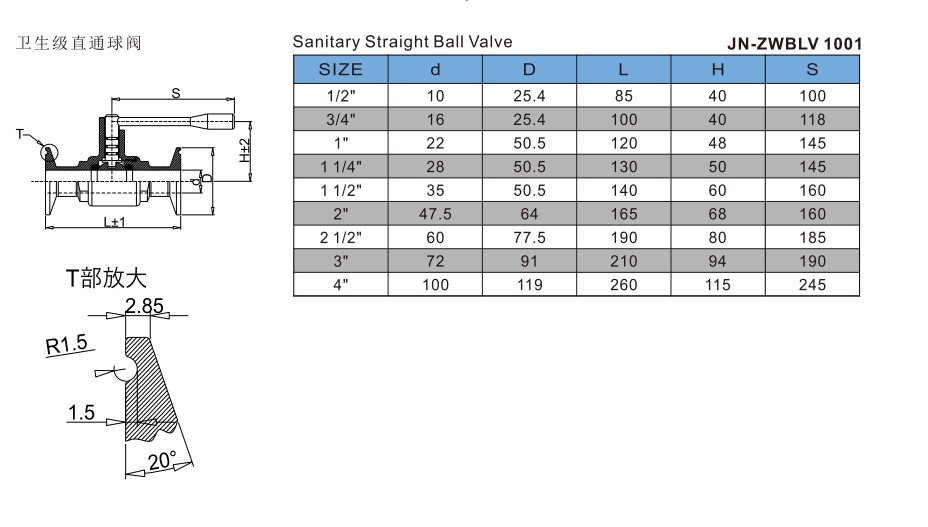
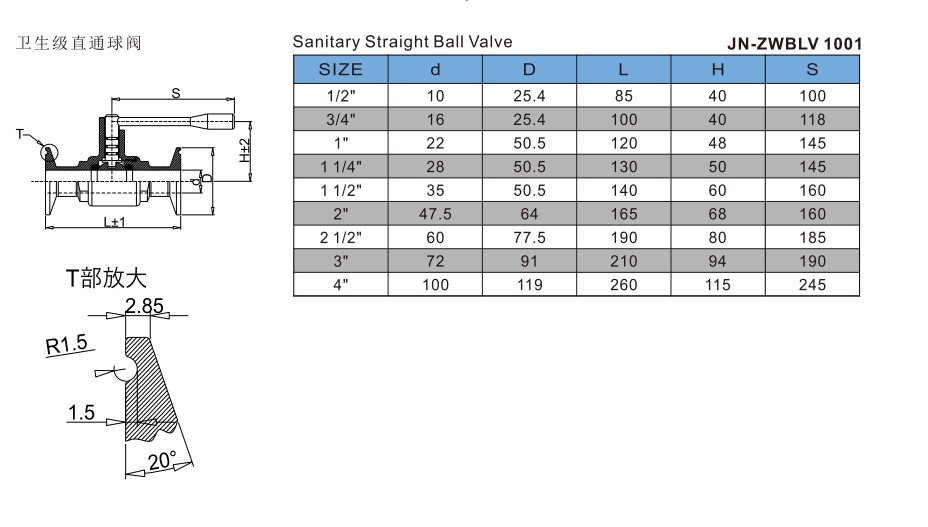
Nominal Diameter:DN15-DN100 (1/2"-4"), customizable for special sizes
Body Material:AISI 304 / 316L Low Carbon Sanitary Stainless Steel, forging forming
Connection Type:Tri-Clamp (Quick Install), conforming to DIN / ISO / 3-A standards
Surface Treatment:Internal Mirror Polishing (Ra≤0.8μm, customizable Ra≤0.2μm), External Electrolytic Polishing
Certification:FDA / 3-A / GMP / CE Certification, material traceability report available
Applicable Medium:Food, beverage, pharmaceutical, daily chemical, fine chemical and other sanitary fluid media




Download directory
Send Message