


Stainless Steel pneumatic actuated 3 way ball valve
JN-3WBLV 1007-1
Size: DN15 – DN150 (1″– 6″, O.D. Ф12.7 – Ф152.4)
Grade: High-quality stainless steel SUS304 or SUS316L, selected to suit various corrosion resistance needs
Standard: Conforms to ISO, DIN, IDF, SMS, 3A, and other internationally recognized standards
Working Pressure: 1.0 MPa (PN10 bar)
Test Pressure:
Shell hydrostatic test: 2.4 MPa
Hydrostatic seat seal test: 1.8 MPa
Temperature Range: -10℃ to +150℃ (steam sterilization up to 150℃ for max 20 min)
PTFE Seals: Standard PTFE seats offer excellent sealing performance, corrosion resistance, and self-lubricating properties, suitable for a wide temperature range
Viton Seals: Optional Viton (FPM) O-rings are available for applications requiring enhanced resistance to high temperatures and aggressive chemicals
Grade: High-quality stainless steel SUS304 or SUS316L, selected to suit various corrosion resistance needs
Standard: Conforms to ISO, DIN, IDF, SMS, 3A, and other internationally recognized standards
Working Pressure: 1.0 MPa (PN10 bar)
Test Pressure:
Shell hydrostatic test: 2.4 MPa
Hydrostatic seat seal test: 1.8 MPa
Temperature Range: -10℃ to +150℃ (steam sterilization up to 150℃ for max 20 min)
PTFE Seals: Standard PTFE seats offer excellent sealing performance, corrosion resistance, and self-lubricating properties, suitable for a wide temperature range
Viton Seals: Optional Viton (FPM) O-rings are available for applications requiring enhanced resistance to high temperatures and aggressive chemicals
Quantity:
Recommend Products
 Stainless Steel pneumatic 3-piece industry floating ball valveSize: DN15 – DN150 (1″– 6″, O.D. Ф12.7 – Ф152.4) Grade: High-quality stainless steel SUS304 or SUS316L, selected to suit various corrosion resistance needs Standard: Conforms to ISO, DIN, IDF, SMS, 3A, and other internationally recognized standards Working Pressure: 1.0 MPa (PN10 bar) Test Pressure: Shell hydrostatic test: 2.4 MPa Hydrostatic seat seal test: 1.8 MPa Temperature Range: -10℃ to +150℃ (steam sterilization up to 150℃ for max 20 min) PTFE Seals: Standard PTFE seats offer excellent sealing performance, corrosion resistance, and self-lubricating properties, suitable for a wide temperature range Viton Seals: Optional Viton (FPM) O-rings are available for applications requiring enhanced resistance to high temperatures and aggressive chemicalsJN-3WBLV 1007-2
- Stainless Steel flange one piece actuated mini ball valveSize: DN15 – DN150 (1″– 6″, O.D. Ф12.7 – Ф152.4) Grade: High-quality stainless steel SUS304 or SUS316L, selected to suit various corrosion resistance needs Standard: Conforms to ISO, DIN, IDF, SMS, 3A, and other internationally recognized standards Working Pressure: 1.0 MPa (PN10 bar) Test Pressure: Shell hydrostatic test: 2.4 MPa Hydrostatic seat seal test: 1.8 MPa Temperature Range: -10℃ to +150℃ (steam sterilization up to 150℃ for max 20 min) PTFE Seals: Standard PTFE seats offer excellent sealing performance, corrosion resistance, and self-lubricating properties, suitable for a wide temperature range Viton Seals: Optional Viton (FPM) O-rings are available for applications requiring enhanced resistance to high temperatures and aggressive chemicalsJN-3WBLV 1007-3
 Stainless Steel high pressure air 3-way electric ball valveSize: DN15 – DN150 (1″– 6″, O.D. Ф12.7 – Ф152.4) Grade: High-quality stainless steel SUS304 or SUS316L, selected to suit various corrosion resistance needs Standard: Conforms to ISO, DIN, IDF, SMS, 3A, and other internationally recognized standards Working Pressure: 1.0 MPa (PN10 bar) Test Pressure: Shell hydrostatic test: 2.4 MPa Hydrostatic seat seal test: 1.8 MPa Temperature Range: -10℃ to +150℃ (steam sterilization up to 150℃ for max 20 min) PTFE Seals: Standard PTFE seats offer excellent sealing performance, corrosion resistance, and self-lubricating properties, suitable for a wide temperature range Viton Seals: Optional Viton (FPM) O-rings are available for applications requiring enhanced resistance to high temperatures and aggressive chemicalsJN-3WBLV 1007-4
 Stainless Steel fire safe hydraulic locking press fitting ball valveSize: DN15 – DN150 (1″– 6″, O.D. Ф12.7 – Ф152.4) Grade: High-quality stainless steel SUS304 or SUS316L, selected to suit various corrosion resistance needs Standard: Conforms to ISO, DIN, IDF, SMS, 3A, and other internationally recognized standards Working Pressure: 1.0 MPa (PN10 bar) Test Pressure: Shell hydrostatic test: 2.4 MPa Hydrostatic seat seal test: 1.8 MPa Temperature Range: -10℃ to +150℃ (steam sterilization up to 150℃ for max 20 min) PTFE Seals: Standard PTFE seats offer excellent sealing performance, corrosion resistance, and self-lubricating properties, suitable for a wide temperature range Viton Seals: Optional Viton (FPM) O-rings are available for applications requiring enhanced resistance to high temperatures and aggressive chemicalsJN-3WBLV 1007-5

Stainless Steel pneumatic actuated 3 way ball valve
TheStainless Steel pneumatic actuated 3 way ball valve is a high-end fluid switching and diversion control core device designed for extremely clean environments such as biopharmaceuticals, aseptic food, dairy products, brewing, water tank foat ball valve and fine chemicals. Its core focus is on the flexible switching, diversion, pneumatic actuated ball valve and merging of fluids in multiple pipelines. Utilizing high pressure ball valve a three-way ball rotary seal design, it achieves efficient control with unobstructed flow, zero leakage, and no residue, completely eliminating secondary and cross-contamination. Driven by a pneumatic actuator, stainless steel ball valve the device offers rapid response and remote control capabilities. Equipped with a sanitary quick-install chuck interface, it allows for rapid disassembly and maintenance, fully meeting the stringent standards of CIP/SIP in-place cleaning and sterilization. Adaptable to the multi-pipeline control needs of automated aseptic production lines, it provides a dual guarantee of hygiene and safety and efficient control for demanding production processes, making it the preferred high-end product for multi-pipeline switching control in aseptic fluid transport systems.
OurStainless Steel pneumatic actuated 3 way ball valve boasts core advantages far exceeding those of similar products, precisely addressing the pain points of multi-pipeline control in the industry: Its three-way ball structure enables precise switching, diversion, or merging of adjacent pipelines, far surpassing the limitation of two-way ball valves that can only switch one path; the ball's rotating sealing design ensures unobstructed flow, low flow resistance, and rapid switching; its 90° angle operation provides excellent sealing performance, far exceeding the switching efficiency and flow capacity of gate valves, diaphragm valves, and other valve types; conventional manual three-way ball valves require manual operation and cannot be adapted to automated production lines, while our pneumatic actuator allows for remote control and rapid response, adapting to the refined control needs of automated aseptic production lines and significantly reducing human error; ordinary industrial-grade three-way ball valves lack sanitary polishing, have dead corners in the flow path, and are prone to media residue, failing to meet cleanroom requirements, while our product uses 316L stainless steel with a mirror finish, complying with FDA/3-A/GMP/ASME BPE standards. With full certification, it leads the way in hygiene, automation, and reversing flexibility. At the same time, compared with flanges and welding, quick-connect connection is more convenient to disassemble and assemble without dead angles, adapting to the high-frequency maintenance needs of clean rooms and perfectly matching the ultra-strict production standards of industries such as biopharmaceuticals and aseptic food.
Accessories
Component & Material Table
- Valve Body & Ball:304/316L Stainless Steel (sanitary-grade forging)
- Valve Seat & Seal Ring:PTFE/EPDM (food-grade, corrosion-resistant)
- Manual Handle:304 Stainless Steel/Aluminum Alloy (anti-slip)
- Quick-clamp Fitting:304/316L Stainless Steel (polished finish)
- Valve Stem:304/316L Stainless Steel (wear-resistant)
Product Parameter Details
- Material:Main body: 304/316L stainless steel; Seals: food-grade PTFE/EPDM; Handle: 304 SS/aluminum alloy
- Structure Form:Standard: three-way L/T port, clamp-type quick-install; Optional: jacketed structure for temperature control
- Pressure Rating:PN10/PN16; 150PSI (working pressure); Test pressure: 1.5× working pressure
- Function:Flow direction switching, media merging, fluid diversion; on-off control for hygienic pipelines
- Grade Classification:Hygiene grade: 3A/DIN 11851; Industry grade: sanitary-grade (for food/pharma), no industrial-grade option
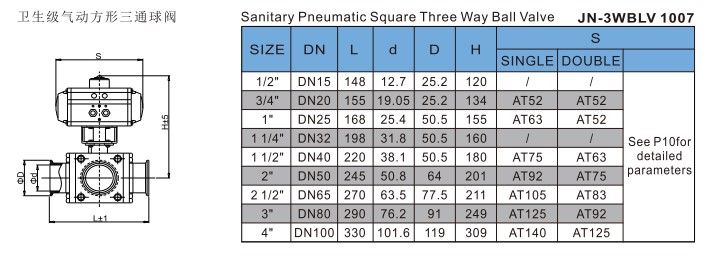
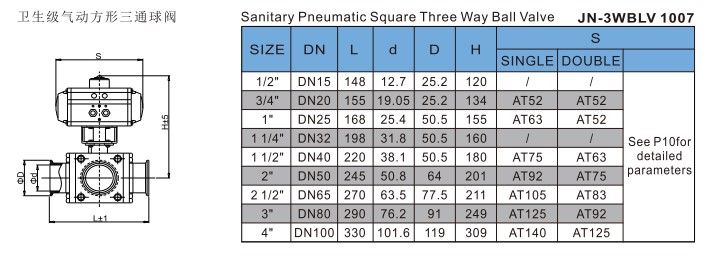
- Specification Match:Standards: DIN (German), SMS (Swedish), 3A (American), ISO (international); Size range: 1/2"–4"
- Certification Grade:Hygiene certification: 3A, FDA; Safety certification: CE, ISO 9001
- Installation Direction:Horizontal/vertical installation (no flow direction restriction; handle upward for easy operation)
- Customization Service:Custom size (5"+), special seal material (Viton), jacketed structure; sample support for testin
Digital advantages
- 1. High-efficiency pneumatic control:Utilizes a high-performance pneumatic actuator with a 90° angle stroke for rapid opening and closing, a response time of ≤0.5 seconds, and remote control and precise positioning (adaptable to adjustable structures). Suitable for automated aseptic production lines and remote monitoring needs, enabling digital management of valve operation. L-type/T-type structures offer consistent control precision with smooth, delay-free switching.
- 2. Compliant and traceable materials: Made of AISI 316L low-carbon stainless steel, each piece comes with a unique traceability code. Scanning the code allows access to 15 core data points, stored in the cloud for 20 years. 100% material compliance rate, meeting FDA/GMP/ASME BPE and EU CE export standards, catering to the compliance needs of export-oriented enterprises and ensuring full product lifecycle traceability. L-type/T-type materials maintain consistent traceability standards.
- 3. Outstanding Sealing Durability: Modified PTFE/EPDM seals have passed 1 million opening and closing tests without leakage, with a service life of 15,000 hours, extending the lifespan by 80% compared to conventional seals. This reduces the frequency of spare parts replacement. The embedded seal design prevents seal misalignment and wear, further enhancing sealing reliability. It is compatible with both L-type and T-type spherical structures for long-term operation.
- 4. Efficient Installation and Disassembly, Saving Costs: Quick-connect clamps allow for tool-free installation and disassembly, requiring only 30 seconds per operation. Suitable for high-frequency cleaning and maintenance scenarios, annual maintenance hours are reduced by 70%, lowering labor costs. It is also compatible with existing cleanroom piping, offering convenient installation without requiring pipe modifications, saving on installation costs. The installation and maintenance processes for L-type and T-type seals are completely identical.
- 5. Strong adaptability to high pressure and high temperature: Rated working pressure 1.6MPa, 100% pass rate in pressure test, can withstand 1500 cycles of 135℃ SIP high-temperature steam sterilization without deformation, adaptable to all sizes from DN15 to DN100, strong corrosion resistance, suitable for various working conditions such as aseptic steam, pharmaceuticals, dairy products, acid and alkaline media, etc., with a wide range of applicable scenarios, and L-type / T-type have completely consistent compatibility.

Stainless Steel pneumatic actuated 3 way ball valve
Feature (F)、Advantage (A)、Benefit (B)
1. Raw Materials
F: The valve body and L-type/T-type balls are forged from AISI 316L low-carbon sanitary stainless steel in a single piece, without splicing or impurities. The raw material furnace number and material report are fully traceable. Thickened valve bodies and special materials can be customized. Cold rolling and bright annealing processes ensure material purity and structural strength. The L-type and T-type balls are made of the same material, differing only in their opening structure.
A: The one-piece forging structure eliminates the risk of intergranular corrosion, is resistant to weak acids and alkalis, resists chloride ion corrosion, and withstands thousands of high-frequency CIP/SIP high-temperature steam sterilization cycles without deformation or harmful substance release. It exhibits stable mechanical properties, high-strength ball sealing structure, and no deformation even after long-term use. High dimensional accuracy ensures precise machining of the L-type corner holes and T-type through holes, resulting in a tight seal.
B: Addresses the industry pain points of conventional three-way ball valves from the source, including uneven material distribution, poor corrosion resistance, easy ball wear, and insufficient machining precision in L-type/T-type structures leading to leakage. Meets FDA/GMP/ASME BPE ultra-high sterility standards, significantly extending product lifespan under highly sterile and automated operating conditions, reducing customer compliance risks and maintenance costs. It is also adaptable to multi-media corrosive conditions, reducing equipment replacement frequency.
2. Manufacturing Process
F: The valve body and L-type/T-type ball are integrally forged without splicing welds. The flow channel undergoes ultra-mirror electrolytic polishing, with a surface roughness Ra≤0.2μm. The ball sealing surface is precision ground and polished, with coaxiality tolerance controlled within ±0.01mm. The L-type corner holes and T-type through holes are precision machined to ensure accurate on/off switching during ball rotation, eliminating jamming and leakage risks.
A: The L-type/T-type ball valve has extremely high precision in its fit with the valve seat, ensuring no misalignment or wear of the seals during long-term operation. The ultra-smooth flow path prevents media adsorption and eliminates cleaning blind spots, completely eliminating microbial growth and media residue. This significantly improves cleaning efficiency while reducing fluid resistance and system energy consumption. It is suitable for high-flow diversion, merging, and reversing requirements, and both structures offer consistent flow path smoothness.
B: This design completely solves the pain points of conventional three-way ball valves, such as gaps in the flow path, cleaning dead zones, and easy residue buildup, as well as the inaccurate reversing of L-type valves and uneven flow diversion of T-type valves. It significantly simplifies the cleaning validation process, reducing cleaning time by more than 60%, ensuring aseptic compliance for customers' large-scale production under high-sterility and automated conditions, reducing compliance audit risks, and improving fluid delivery and switching efficiency.
3. Structural Design
F: 90° angular stroke spherical rotating structure for the tee, pneumatic actuator drive, quick-release chuck connection, compact one-piece forged structure, full-flow arc design with no dead angles. The L-type allows for reversing between adjacent tees, while the T-type allows for diversion, merging, and full tee passage. The flow channel is optimized for fluid dynamics to ensure smooth, unobstructed flow of fluids in both directions.
A: No gaps for dirt accumulation, no dead angles for media retention, suitable for smooth flow through multiple pipelines for diversion, merging, and reversing. No turbulence, no foaming, no media stratification. Seamless structure resists pressure and deformation, suitable for continuous sterile steam delivery. A single valve enables multi-pipeline reversing, diversion, and merging, significantly simplifying pipeline layout, replacing traditional multi-valve combinations, saving installation space and pipeline costs. L-type/T-type can be selected as needed to adapt to different process requirements.
B: Avoids the industry pain points of conventional three-way ball valves, which are limited to simple reversing, and manual ball valves, which cannot be automated, and whose L-type and T-type structures cannot be flexibly adapted. It ensures batch stability and sterility in multi-pipeline fluid transportation, and is suitable for large-scale, automated, and continuous production in ultra-clean areas such as biopharmaceuticals and aseptic food, reducing customers' unplanned downtime costs and pipeline laying costs.
4. Key Features and Advantages
F: Standard sanitary quick-connect clamp interface, disassembly and assembly require no special tools, single operation takes only 30 seconds, all-stainless steel pneumatic actuator design, rapid response, remote control capability, mirror polished inner and outer surfaces, no dust accumulation, no bacterial contamination, no media residue, L-type/T-type dual structures available, flexibly adaptable to different scenarios such as reversing, diverting, and merging.
A: Quick-connect design adapts to clean pipelines requiring frequent maintenance, reducing single-disassembly and assembly time by 70% compared to welded types. It withstands high-frequency CIP/SIP high-temperature steam erosion, and its ball seal reliability far surpasses other valve types. The pneumatic actuator enables automated control, eliminating the need for manual operation, improving aseptic production efficiency, reducing human error, and allowing for PLC remote control. It adapts to the needs of automated production lines. The L-type directional control is precise, and the T-type flow distribution is uniform, meeting the refined control requirements of different processes.
B: Addressing the industry pain points of conventional three-way ball valves—limited functionality, insufficient hygiene standards, and lack of automation—it significantly improves the aseptic safety and automation level of customers' pipeline systems, reduces manual maintenance and production compliance costs, helps enterprises achieve digital and intelligent upgrades, reduces pipeline leaks, improves system operational stability, and adapts to multi-scenario process requirements.
5. Sealing Ring Features
F: FDA/GMP dual-certified food-grade and pharmaceutical-grade modified PTFE/EPDM seals. The embedded sealing design prevents misalignment and media penetration. The sealing surface is ultra-precision machined to ensure a perfect fit. Selection can be made according to media characteristics. The seal has uniform thickness, high toughness, and is easy to replace. It is compatible with both L-type and T-type spherical structures, providing consistent sealing performance.
A: The seals do not age, detach, or break under long-term operating conditions. They fit seamlessly with L-type/T-type spheres, are resistant to high and low temperatures, corrosion, and high-pressure steam. They maintain zero-leakage sealing performance even after tens of thousands of opening and closing cycles and thermal cycles. The PTFE seal life can reach over 1 million cycles, far exceeding the service life of conventional seals. It is adaptable to different media and operating conditions.
B: Eliminates the industry pain points of conventional three-way ball valves, such as easy aging of seals, high leakage rate, easy contamination, and frequent replacement. Significantly reduces the frequency of seal replacement for customers, reduces spare parts replacement costs, ensures stable operation of continuous aseptic delivery of multi-pipeline fluids, extends equipment maintenance cycle, avoids product contamination and production accidents caused by seal leakage, and is compatible with the long-term stable operation of both L-type and T-type structures.
F: The valve body and L-type/T-type balls are forged from AISI 316L low-carbon sanitary stainless steel in a single piece, without splicing or impurities. The raw material furnace number and material report are fully traceable. Thickened valve bodies and special materials can be customized. Cold rolling and bright annealing processes ensure material purity and structural strength. The L-type and T-type balls are made of the same material, differing only in their opening structure.
A: The one-piece forging structure eliminates the risk of intergranular corrosion, is resistant to weak acids and alkalis, resists chloride ion corrosion, and withstands thousands of high-frequency CIP/SIP high-temperature steam sterilization cycles without deformation or harmful substance release. It exhibits stable mechanical properties, high-strength ball sealing structure, and no deformation even after long-term use. High dimensional accuracy ensures precise machining of the L-type corner holes and T-type through holes, resulting in a tight seal.
B: Addresses the industry pain points of conventional three-way ball valves from the source, including uneven material distribution, poor corrosion resistance, easy ball wear, and insufficient machining precision in L-type/T-type structures leading to leakage. Meets FDA/GMP/ASME BPE ultra-high sterility standards, significantly extending product lifespan under highly sterile and automated operating conditions, reducing customer compliance risks and maintenance costs. It is also adaptable to multi-media corrosive conditions, reducing equipment replacement frequency.
2. Manufacturing Process
F: The valve body and L-type/T-type ball are integrally forged without splicing welds. The flow channel undergoes ultra-mirror electrolytic polishing, with a surface roughness Ra≤0.2μm. The ball sealing surface is precision ground and polished, with coaxiality tolerance controlled within ±0.01mm. The L-type corner holes and T-type through holes are precision machined to ensure accurate on/off switching during ball rotation, eliminating jamming and leakage risks.
A: The L-type/T-type ball valve has extremely high precision in its fit with the valve seat, ensuring no misalignment or wear of the seals during long-term operation. The ultra-smooth flow path prevents media adsorption and eliminates cleaning blind spots, completely eliminating microbial growth and media residue. This significantly improves cleaning efficiency while reducing fluid resistance and system energy consumption. It is suitable for high-flow diversion, merging, and reversing requirements, and both structures offer consistent flow path smoothness.
B: This design completely solves the pain points of conventional three-way ball valves, such as gaps in the flow path, cleaning dead zones, and easy residue buildup, as well as the inaccurate reversing of L-type valves and uneven flow diversion of T-type valves. It significantly simplifies the cleaning validation process, reducing cleaning time by more than 60%, ensuring aseptic compliance for customers' large-scale production under high-sterility and automated conditions, reducing compliance audit risks, and improving fluid delivery and switching efficiency.
3. Structural Design
F: 90° angular stroke spherical rotating structure for the tee, pneumatic actuator drive, quick-release chuck connection, compact one-piece forged structure, full-flow arc design with no dead angles. The L-type allows for reversing between adjacent tees, while the T-type allows for diversion, merging, and full tee passage. The flow channel is optimized for fluid dynamics to ensure smooth, unobstructed flow of fluids in both directions.
A: No gaps for dirt accumulation, no dead angles for media retention, suitable for smooth flow through multiple pipelines for diversion, merging, and reversing. No turbulence, no foaming, no media stratification. Seamless structure resists pressure and deformation, suitable for continuous sterile steam delivery. A single valve enables multi-pipeline reversing, diversion, and merging, significantly simplifying pipeline layout, replacing traditional multi-valve combinations, saving installation space and pipeline costs. L-type/T-type can be selected as needed to adapt to different process requirements.
B: Avoids the industry pain points of conventional three-way ball valves, which are limited to simple reversing, and manual ball valves, which cannot be automated, and whose L-type and T-type structures cannot be flexibly adapted. It ensures batch stability and sterility in multi-pipeline fluid transportation, and is suitable for large-scale, automated, and continuous production in ultra-clean areas such as biopharmaceuticals and aseptic food, reducing customers' unplanned downtime costs and pipeline laying costs.
4. Key Features and Advantages
F: Standard sanitary quick-connect clamp interface, disassembly and assembly require no special tools, single operation takes only 30 seconds, all-stainless steel pneumatic actuator design, rapid response, remote control capability, mirror polished inner and outer surfaces, no dust accumulation, no bacterial contamination, no media residue, L-type/T-type dual structures available, flexibly adaptable to different scenarios such as reversing, diverting, and merging.
A: Quick-connect design adapts to clean pipelines requiring frequent maintenance, reducing single-disassembly and assembly time by 70% compared to welded types. It withstands high-frequency CIP/SIP high-temperature steam erosion, and its ball seal reliability far surpasses other valve types. The pneumatic actuator enables automated control, eliminating the need for manual operation, improving aseptic production efficiency, reducing human error, and allowing for PLC remote control. It adapts to the needs of automated production lines. The L-type directional control is precise, and the T-type flow distribution is uniform, meeting the refined control requirements of different processes.
B: Addressing the industry pain points of conventional three-way ball valves—limited functionality, insufficient hygiene standards, and lack of automation—it significantly improves the aseptic safety and automation level of customers' pipeline systems, reduces manual maintenance and production compliance costs, helps enterprises achieve digital and intelligent upgrades, reduces pipeline leaks, improves system operational stability, and adapts to multi-scenario process requirements.
5. Sealing Ring Features
F: FDA/GMP dual-certified food-grade and pharmaceutical-grade modified PTFE/EPDM seals. The embedded sealing design prevents misalignment and media penetration. The sealing surface is ultra-precision machined to ensure a perfect fit. Selection can be made according to media characteristics. The seal has uniform thickness, high toughness, and is easy to replace. It is compatible with both L-type and T-type spherical structures, providing consistent sealing performance.
A: The seals do not age, detach, or break under long-term operating conditions. They fit seamlessly with L-type/T-type spheres, are resistant to high and low temperatures, corrosion, and high-pressure steam. They maintain zero-leakage sealing performance even after tens of thousands of opening and closing cycles and thermal cycles. The PTFE seal life can reach over 1 million cycles, far exceeding the service life of conventional seals. It is adaptable to different media and operating conditions.
B: Eliminates the industry pain points of conventional three-way ball valves, such as easy aging of seals, high leakage rate, easy contamination, and frequent replacement. Significantly reduces the frequency of seal replacement for customers, reduces spare parts replacement costs, ensures stable operation of continuous aseptic delivery of multi-pipeline fluids, extends equipment maintenance cycle, avoids product contamination and production accidents caused by seal leakage, and is compatible with the long-term stable operation of both L-type and T-type structures.

Stainless Steel pneumatic actuated 3 way ball valve
Nominal Diameter:DN15~DN100 (1/2"~4")
Body Material:AISI 316L low carbon sanitary grade stainless steel, 3-way forged, custom thickened body available
Ball Type:L-port / T-port (optional), hollow ball, precision machining
Seal Accessory:Modified PTFE (standard), food grade EPDM/silicone (optional), FDA & GMP certified
Connection Type:Sanitary clamp connection (standard, compliant with DIN/3-A/SMS/ISO)
Working Temperature:Long-term: -20℃~180℃; Short-term SIP sterilization: ≤135℃
Surface Treatment:Electrolytic polishing + ultra-mirror polishing, inner/outer flow channel Ra≤0.2μm, sealing surface Ra≤0.1μm, no dead ends




Send Message