
What is a colloid mill used for?
author: 003
2026-07-18
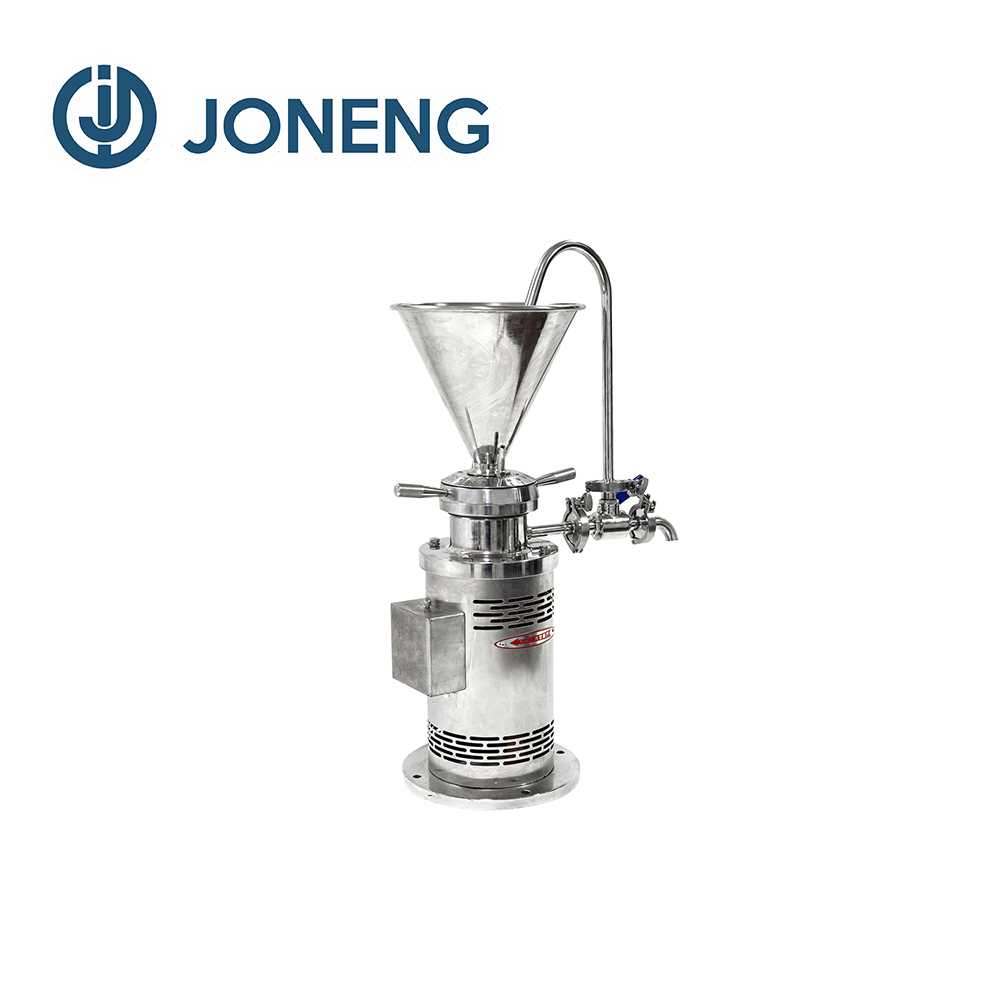
What is a colloid mill used for?
A colloid mill is an ultrafine grinding device that integrates grinding, emulsification, homogenization, and dispersion functions. Its core purpose is to rapidly grind solid particles or droplets in liquid-solid or liquid-liquid mixtures to the micron level using the powerful shearing force, friction, high-frequency vibration, and vortex effect generated between a high-speed rotating rotor and a stationary stator, forming highly homogeneous and stable suspensions or emulsions. The specific applications of colloid mills in various fields are detailed below.
I. Food Industry: The Shaper of Texture and Stability Colloid mills occupy an absolutely core position in food processing. Almost all fluid foods that pursue a delicate texture and prevent separation cannot do without them.
Colloid mills hold an absolutely core position in food processing; almost all liquid foods requiring a delicate texture and prevention of separation rely on them. II. Chemical Industry: Experts in Dispersion and Emulsification
1. Coatings, Pigments, and Inks
Colloid mills can grind and disperse pigment particles to the submicron level, improving coloring power and hiding power, and preventing pigment sedimentation and clumping during storage. Ultra-fine dispersion in water-based coatings, printing inks, and printer inks all depend on them.
Colloid mills can grind and disperse pigment particles to the submicron level, improving coloring power and hiding power, and preventing pigment sedimentation and clumping during storage. Ultra-fine dispersion in water-based coatings, printing inks, and printer inks all depend on them.
2. Greases and Sealing Materials
The production of greases such as lithium-based and calcium-based greases requires the uniform dispersion of thickeners in base oils to form a stable gel structure. The strong shearing force of colloid mills refines soap fibers, improving the mechanical stability and colloidal stability of greases. Furthermore, they are widely used in the preparation of silicone sealants and asphalt emulsions.
The production of greases such as lithium-based and calcium-based greases requires the uniform dispersion of thickeners in base oils to form a stable gel structure. The strong shearing force of colloid mills refines soap fibers, improving the mechanical stability and colloidal stability of greases. Furthermore, they are widely used in the preparation of silicone sealants and asphalt emulsions.
3. Fine Chemical Products
Various emulsified waxes, defoamers, release agents, leather fatliquoring agents, etc., all require the mixing of oil and water or resin phases using colloid mills to produce stable emulsions with uniform particle size.
Various emulsified waxes, defoamers, release agents, leather fatliquoring agents, etc., all require the mixing of oil and water or resin phases using colloid mills to produce stable emulsions with uniform particle size.
II. Pharmaceuticals and Cosmetics: From the Minimalism to the Perfection
1. Pharmaceuticals: Ointments, creams, gels, oral suspensions, syrups, etc. Colloid mills can micronize poorly soluble drugs, improving bioavailability. In the preparation of topical hormone creams or antibiotic ointments, grinding the active ingredient and matrix together ensures uniform drug distribution and eliminates "hot spots" of efficacy. Some traditional Chinese medicine ointments and decoctions are also processed using colloid mills to treat herbal extracts.
2. Cosmetics: Face creams, lotions, shampoos, shower gels, toothpaste, etc. Cosmetic formulations often contain various oily ingredients and solid micronized powders (such as titanium dioxide and talc). Colloid mills can rapidly shear these components with an aqueous phase at room temperature or with appropriate heating, directly forming a fine, glossy paste. This requires no prolonged stirring, is highly efficient, and produces a stable product without separation.
2. Cosmetics: Face creams, lotions, shampoos, shower gels, toothpaste, etc. Cosmetic formulations often contain various oily ingredients and solid micronized powders (such as titanium dioxide and talc). Colloid mills can rapidly shear these components with an aqueous phase at room temperature or with appropriate heating, directly forming a fine, glossy paste. This requires no prolonged stirring, is highly efficient, and produces a stable product without separation.
III. Other Fields
Construction and Environmental Protection: Dispersion of bentonite slurry, polymer-modified emulsified asphalt, and water-based waterproof coatings.
Paper Industry: Pigment dispersion, emulsification preparation of pulp sizing agents and coating agents.
Biological and Daily Chemical Industries: Biological tissue homogenates (laboratory), cleaning pastes, shoe polish, etc.
Paper Industry: Pigment dispersion, emulsification preparation of pulp sizing agents and coating agents.
Biological and Daily Chemical Industries: Biological tissue homogenates (laboratory), cleaning pastes, shoe polish, etc.
IV. Why do the core advantages of colloid mills enable these applications?
Compared to traditional grinding or mixing equipment, colloid mills offer several key advantages:
Fully enclosed and continuous operation:** They can be equipped with pipelines and tanks for circulating or single-pass production, ensuring hygiene and eliminating splashes, making them suitable for food-grade cleanrooms.
Adjustable grinding head gap:** Precisely adjustable from 0.01 to 2 mm via a handwheel, meeting a wide range of needs from coarse to ultrafine grinding, with a fineness of 2 to 50 microns.
Multi-functional integration:** A single machine can simultaneously perform grinding, homogenization, emulsification, and mixing, eliminating the need for multiple machines and complex processes.
Safe and easy-to-clean materials:** Most material-contact parts are made of 304 or 316L stainless steel. The modular design allows for complete disassembly, eliminating blind spots and meeting the cleaning needs of frequent product changes.
Fully enclosed and continuous operation:** They can be equipped with pipelines and tanks for circulating or single-pass production, ensuring hygiene and eliminating splashes, making them suitable for food-grade cleanrooms.
Adjustable grinding head gap:** Precisely adjustable from 0.01 to 2 mm via a handwheel, meeting a wide range of needs from coarse to ultrafine grinding, with a fineness of 2 to 50 microns.
Multi-functional integration:** A single machine can simultaneously perform grinding, homogenization, emulsification, and mixing, eliminating the need for multiple machines and complex processes.
Safe and easy-to-clean materials:** Most material-contact parts are made of 304 or 316L stainless steel. The modular design allows for complete disassembly, eliminating blind spots and meeting the cleaning needs of frequent product changes.
In short, colloid mills have applications spanning various levels of use, from food and coatings to smears and other applications. They are found in almost any scenario requiring the fine dispersion of solids in liquids or the perfect emulsification of two insoluble liquids. For small-scale producers, correctly understanding and utilizing the many uses of colloid mills is a key step in upgrading product quality and developing differentiated new products.
Installation guide for a threaded stainless steel check valve
Should the pressure rating of a sanitary plug valve be selected based on pipeline pressure or media conditions?
Related Article

The sanitary butterfly valve is the most-specified valve in any hygienic plant — cheap, compact, fast and easy to clean. It is also the valve most often mis-specified, which is why a unit that "looked fine on paper" starts leaking after one CIP season. This guide covers the seven decisions that determine whether your butterfly valve holds up: seat material, connection and standard, actuation, torque sizing, finish and maintenance.
Sanitary Butterfly Valve Selection Guide: How to Specify a Hygienic Butterfly Valve

"Send us a 2-inch valve." Sounds simple — until the DIN line, the ISO line and the American line all turn out to have different outside diameters. Here is the comparison table our engineers use every day, and the five rules that prevent 90% of sanitary connection mistakes.
Sanitary Tube and Valve Standards Compared: DIN 11850, ISO 2037, SMS 3008, BS 4825 and ASME BPE

In hygienic plants, seals — not valve bodies — cause over 80% of valve service issues, and most of them announce themselves weeks in advance. This guide walks through the symptoms our service engineers meet most often, what each one really means, and the maintenance rhythm that keeps AB valves leak-free for years.
Sanitary AB Valve Troubleshooting: Leakage, Seal Failure and Sticking — Causes, Fixes and a Maintenance Schedule

Surface treatments fall into three categories: chemical (addressing corrosion resistance), mechanical (addressing appearance), and electrochemical (addressing both). When selecting a method, first consider three factors: the required level of corrosion resistance, the strictness of cleanliness standards, and the budget.
Differences in Surface Treatment Processes for Pipe Fittings and Selection Guidelines